
























Our Ethics
We have 3 golden rules for everything we do:

1. Everything we sell must be Fair Trade

2. We should always strive to have as little environmental impact as possible
3. We should make a positive social impact wherever we can.
1. Our Commitment to Fair Trade
We’re proud to uphold the principles of Fair Trade, valuing our producers’ skills, traditions, and their communities.
We only work with producers we know personally and visit them as often as we can. This means we’re able to guarantee that all aspects of our business follow the guidelines as set out by the World Fair Trade Organisation (WFTO) and the British Association for Fair Trade Shops (BAFTS). We’ve seen for ourselves the positive impact Fair Trade has, and we’re determined to support this as much as possible through our business.

What does it mean to be Fair Trade?
Fair Trade is a system that ensures a certain set of standards are met when products or ingredients are produced. Providing rights for workers, safer working conditions, and a fair standard of pay, it means that the incredible people who make our products are treated as well as they should be.
What’s different about the way we work with our producers?

- We always pay at least 50% upfront for all of our orders, send extra when it’s needed, and pay the full remaining balance as soon as we’ve received the order.
- We work collaboratively with our producers on the development of new products to respect the traditional designs and techniques they use.
- Wherever possible we ensure our producers are using local, traditionally made materials in order to cut the carbon footprint and keep work within the local community.
- We aim to visit our producers at least once a year to exchange feedback, discuss future improvements, plans, and products, and to keep our relationship strong.
2. Reducing Our Environmental Impact
Products
All our products are created with planet-friendly materials wherever possible. For example:
- You’ll find paper made from cotton rags salvaged from the waste of the Indian garment industry
- Photo frames crafted from recycled newspaper
- Christmas baubles blown from recycled glass
- Decorative signs cast in recycled metal
- We also use sustainable materials like merino wool, Lokta shrub, Munja grass and mango wood.
Most importantly, we choose quality materials that last well to live long, happy lives in your homes. Check out our Care Guide for some tips on looking after your Paper High products.
Our commitments
We’re committed to becoming fully plastic-free with all our product packaging, and we’re working with our producers to reduce this.
We never throw products away; sometimes we receive products from our suppliers that are not quite up to our high standards. As part of our ethos, we never send anything back to our suppliers, withhold payment or dispose products. Instead, we list them on eBay at a heavily reduced price to ensure they still find a home. Check out our eBay shop here.
Paper High HQ
Here in the UK we hold true to these values too:
- All of our postal packaging is fully recyclable – even the bubble wrap!
- We reuse the boxes from our producers to pack our trade orders, and you might notice your box is filled with shredded junk mail and wastepaper
- We minimise our carbon footprint by importing goods by sea rather than air whenever possible
- We’re sure to offset our carbon emissions every time we visit our producers
- We have a Climate Action website which means we automatically compensate the estimated CO₂ emissions it generates by planting trees
- Every month, we plant 200 trees with Tree-Nation, and 50 trees with Treefo
Sustainable staff travel
Our commitment doesn’t stop after 5pm. The way our staff travel to and from work is just as important as the sustainability of our products.
Our HQ in Lewes is well connected to local bus routes and train services. We also offer sustainable travel incentives to all our members of staff including the national cycle to work scheme and car sharing initiatives.
3. Making a Positive Social Impact
We carefully select our producers with the aim of building long-term partnerships. Our hope is that our business not only supports their livelihoods but also strengthens their families and local communities. By growing together in a mutually beneficial way, we can plan confidently for the future.
We’re equally committed to giving back closer to home. Whenever possible, we support local charities – including past donations to the Brighton Food Bank and stationery for nearby primary schools.
Our work with Get Paper Industries
We’re always looking for ways to help out, whether financially or through hands-on support. Our gift-wrap producer, Get Paper Industries, runs extensive community initiatives, including the Anita Milan International Academy, a school for disadvantaged children in Kathmandu. We’re proud to sponsor 17 girls there – a number that’s grown thanks to our annual Fair Trade Fortnight events.
Although they don’t use trees to make their paper, Get Paper Industries has planted them since 1995. Each year, they set a reforestation target based on exports, planting 17 trees for every ton of paper shipped abroad (the amount of timber required to produce one ton of machine‑made paper). Their site near the Kathmandu factory brings producers and community members together for annual planting days. Since tracking began in 2011, 36,109 trees have been planted.
In 2025, the initiative expanded when six partner schools and key suppliers joined the programme. A shortage of saplings led Get Paper Industries to launch their own on-site nursery, enabling them to double the number of trees planted each year. The British Ambassador to Nepal, Rob Fenn, officially inaugurated the nursery.
During Fair Trade Fortnight 2025, we donated 10% of our retail sales to support this sapling project.

Anita Milan International Academy, a school established by Get Paper Industries.
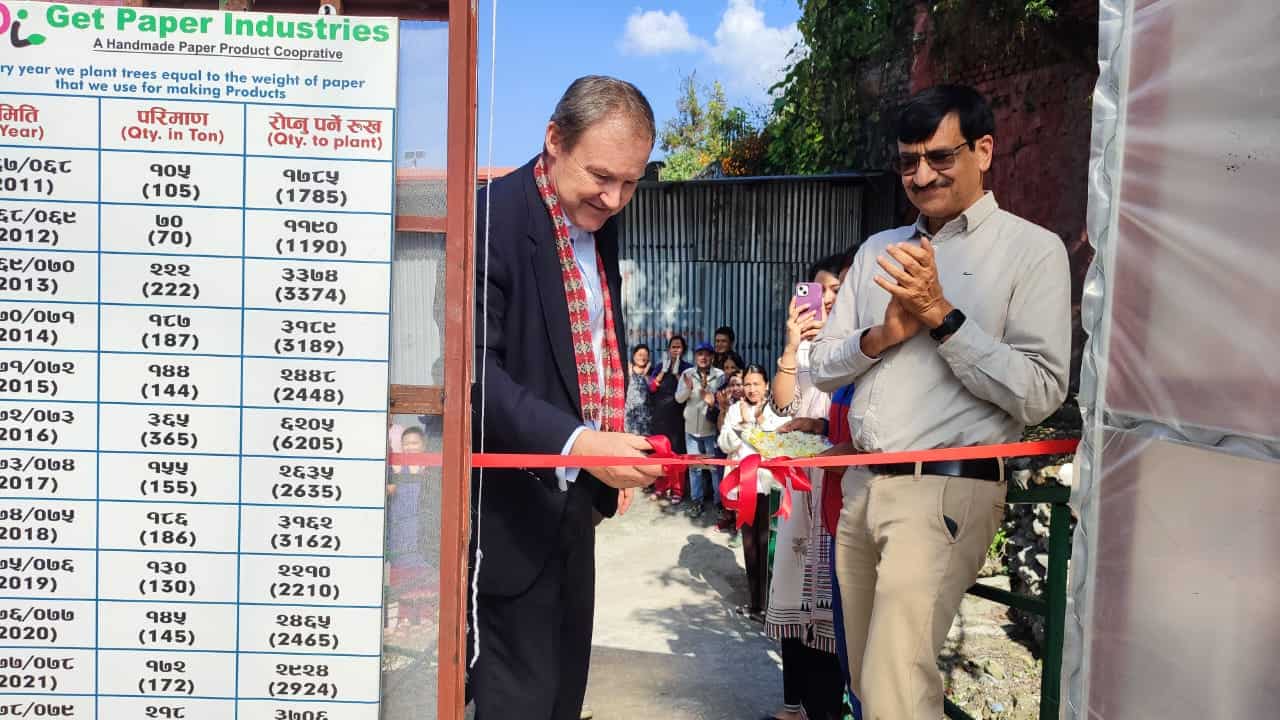
British Ambassador to Nepal, Rob Fenn, inaugurating the new sapling nursery with Milan from Get Paper Industries in 2025.